The 2027 AML package: a gap analysis for your entity
What actually changes. What does not. What your firm needs to do.
28 minutes 40 seconds of instruction. 12 focused lessons. Gap analysis included. Primary sources linked.
For compliance officers, conducting officers, in-house counsel and fund and ManCo staff who already work under the Luxembourg framework.
Regulation (EU) 2024/1624 applies from 10 July 2027 and replaces much of what you do today with directly applicable rules. What direct applicability does to the citations in your own procedures, the three figures from the package that are quoted wrongly almost every time, which of the two roles of the AMLA will ever reach your entity, what harmonised due diligence costs a group, the training obligation extended beyond your employees, and the gap analysis itself: eight rows, four columns, sequenced by lead time rather than by importance.
What you can do afterwards. Know what changes and what does not, with an action plan sequenced by lead time.
See the teaching before you pay. Two lessons of this course are open with no account and no payment, and every lesson lists the instruments it is built from with a link to the official text, so the material is on the table before the price is. Access runs 12 months from the day you buy and includes every update published to this course in that time.
Expensing it? Ask for the invoice to be made out to your firm, with its VAT number, billing address and your purchase order reference. Buying for several people instead: seats for a team, or how teams and invoices work.
Content version: 25 September 2026. The terms of sale are available in full at checkout.
Regulation (EU) 2024/1624 applies from 10 July 2027
Article 90 of the Regulation carries the application date. From that day the rules apply directly, and the work that has to be done before it, the gap analysis, the citation work and the procedures that name a directive rather than a regulation, is sequenced by lead time rather than by the date itself. The later date of 10 July 2029 applies to professional football clubs and agents.
Regulation (EU) 2024/1624, Official Journal textMost of what you do survives the transition. The work is in the part that does not
Regulation (EU) 2024/1624 applies from 10 July 2027 without a Luxembourg law in between. Almost every obligation you carry is restated rather than removed, but every procedure, policy and template you own cites Luxembourg provisions that will no longer carry the obligation, and nobody is going to do that renumbering for you.
Regulation (EU) 2024/1624 applies from 10 July 2027 and parts of the framework around it do not exist yet: delegated acts and technical standards are still to come, and Directive (EU) 2024/1640 still has to be transposed into Luxembourg law. This course states which of its rows rest on the text as adopted and which rest on an instrument that is still being written, and it does not present a recital as an obligation.
Module 7 of the AML/CFT and KYC course covers this same 2027 package in three lessons: what direct applicability changes, the two roles of the AMLA, and a gap analysis sequenced by lead time. This course is the long form of that module. If you own the AML course you already have the summary, and what you are buying here is the detail, the worked gap analysis and its own assessments and certificates. Module 7 is at lesson 7.1.
Four modules
Four modules and 12 lessons, each with its transcript and its own source register, lessons 1.1 and 1.2 free to watch. An assessment closes every module and a certificate is issued for each one, and the course closes with an end-of-course assessment drawing on all four modules.
Module 1. What actually changes
What direct applicability does to the citations in your own procedures, the three figures from the package that are quoted wrongly almost every time, and how to sort the whole thing into the pile that is a restatement and the pile that is genuinely new.
Learning objectives
- Explain what changes when an obligation stops arriving through a Luxembourg transposition and applies directly under Regulation (EU) 2024/1624, and identify the citation work that follows across the entity own procedures.
- State the three figures the way the text states them: the EUR 10 000 cash limit as a ceiling member states may lower, the 25 per cent beneficial ownership threshold with the power to lower it to at most 15 per cent by delegated act, and the application date of 10 July 2027 with 10 July 2029 for professional football clubs and agents.
- Sort the package into the larger pile of obligations that are restated and the smaller pile that is genuinely new, and recognise that Directive (EU) 2024/1640 still arrives through national transposition.
Module 2. The AMLA
The two roles of the new authority and which of them will ever reach your entity, the difference between being eligible for consideration and being selected, and the convergence that has already started through the questions your supervisor asks.
Learning objectives
- Distinguish the two roles of the AMLA: direct supervision of a small number of selected entities, and the standard setting and coordination that reaches every entity through its own national supervisor.
- State in one sentence whether the entity falls within the population the CSSF identified in its circular of June 2026 as eligible for consideration, and that eligibility is not selection.
- Explain what the CSSF use of AMLA data collection templates through its circular letters of February and March 2026 means for how the entity answers are compared, and why producing data in a defined shape is a systems question before it is a policy one.
Module 3. What changes in substance
Harmonised due diligence and what a group loses when national variation closes, the training obligation documented in its realisation and extended beyond your employees, and the fund and management company overlap that a recital looks at without deciding.
Learning objectives
- Explain what harmonisation of the detail of customer due diligence closes for a group that has organised around national variation, and why convergence is upward rather than downward.
- Identify the population the documented training obligation reaches beyond employees, including agents and distributors, and the evidence that will satisfy the annual verification the entity is already subject to.
- Document who performs each element of due diligence between a fund and its management company and where the delegation sits, while stating accurately what a recital does and does not do.
Module 4. Running the gap analysis
The table itself: four columns, about eight rows, every one of them already met in this course, the sequencing rule that decides whether the plan produces anything at all, and how the analysis stays alive through the delegated acts still to come and is summarised to a board in five minutes.
Learning objectives
- Build the gap analysis as a table of about eight rows and four columns (where you are now, where you need to be, who owns it, and by when) using rows the course has already established.
- Sequence the rows by lead time rather than by importance, separating work that can start now and takes months, work that is an afternoon, and work that cannot start until a delegated act, a technical standard or a national transposition exists.
- Keep the analysis alive with a named owner, a review date and defined triggers, and summarise it to a board in five minutes as what is not changing, what is, what is under way, and what is being waited on.
Final item. The end-of-course assessment
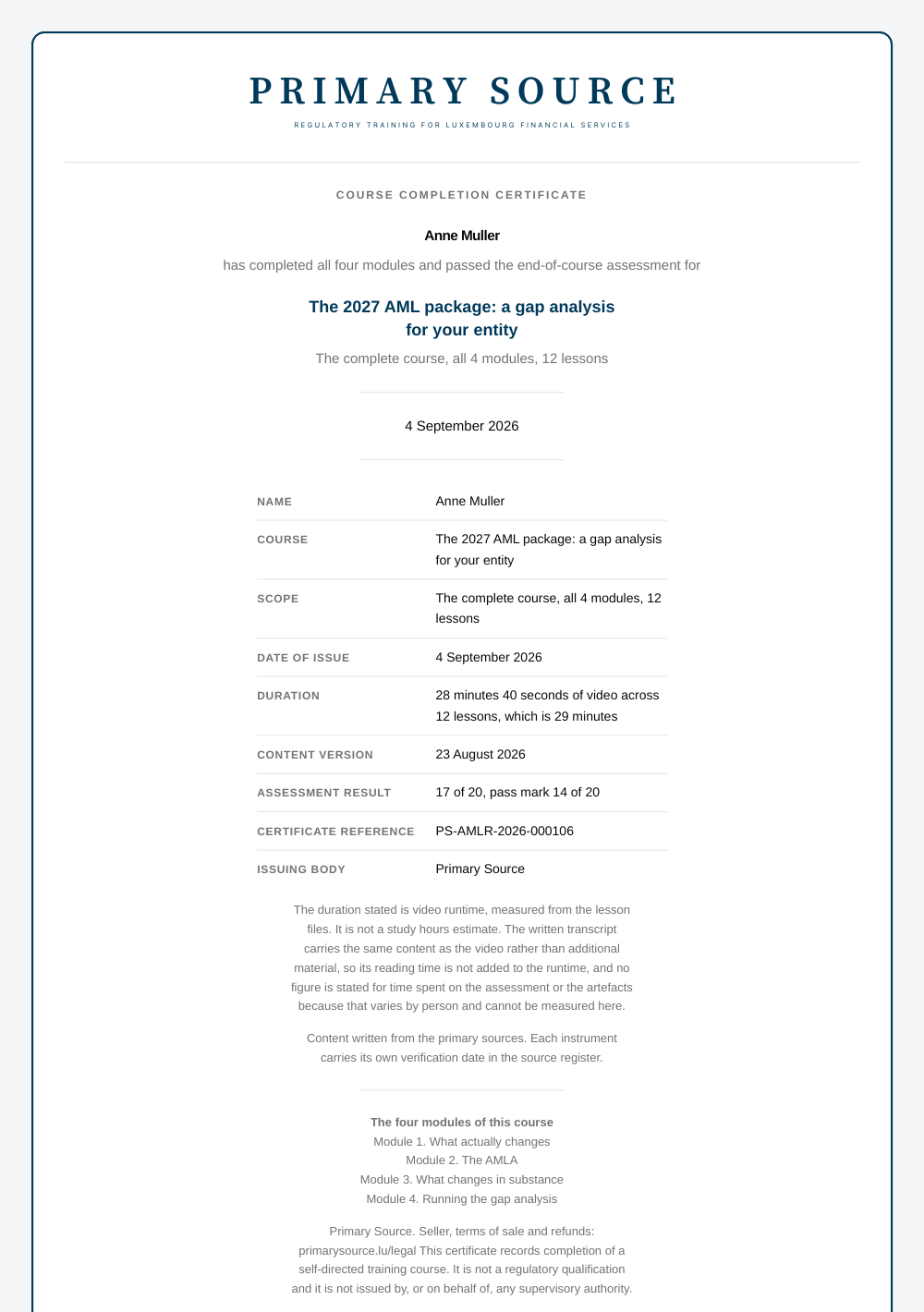
20 questions across all four modules, pass mark 14 of 20, which is 70 percent. Passing issues a course completion certificate recording the content version and the runtime of 28 minutes 40 seconds across 12 lessons.
Everything you get for the price
- Video lessonsEvery lesson is built around a single point you can act on the same day, with playback speed control.
- Full written transcriptsThe narration of every lesson word for word, so you can read the course instead of watching it.
- A reading version that printsEach module as one continuous article, typeset for reading in one sitting and for saving as a PDF.
- An assessment with a certificate of completionA scored assessment for every module, with its question count and pass mark shown before you start, retakeable without limit. The certificate carries your name, the module, the date, the content version and the legal references it covered.
- The artefactsWorking documents, not slides: gap assessment for the 2027 package, source register. They print through the browser, and the gap assessment saves what you type against your organisation and exports as CSV.
- Every legal source linked to its official textEach lesson ends with its sources, each resolving to the official text on Legilux, cssf.lu or EUR-Lex.
Stated openly, before you spend anything
- NoNo legal adviceTraining material, not advice on your entity or your file.
- NoNo accreditation by any bodyThe certificate of completion is issued by this project alone. It is not an official qualification.
- NoNo guarantee of any career outcomeNo job, no promotion, no appointment as RC or RR, and no approval of any person by any authority.
- NoNo live tuitionEverything is recorded, and you work at your own pace.
Concise by design. The narrated video runs about 29 minutes across 12 lessons, which is short on purpose: there is no filler, no restated slide and no reading out of the law. What takes the time is what you do with it, the transcripts, the source registers, the 4 module assessments and the artefacts you fill in for your own entity.
The same course for several people
- Team price 499 euros for 5 peopleOne seat each, 12 months from the date of purchase.
- Team price 899 euros for 10 peopleOne seat each, 12 months from the date of purchase.
- Larger teamsLarger teams by arrangement, through the contact page.
A team is bought in the entity's name: the checkout takes the legal name and billing address, with a VAT number if you have one. Pay by card and the seats open at once, or ask for an invoice and pay it by bank transfer. Each seat is activated by the employee it is sent to.
The certificate and the artefacts, before you buy them
Both of these are normally behind the paywall. They are shown here because the two questions that decide this purchase are what the training file gets and whether the artefacts are working documents or slides.
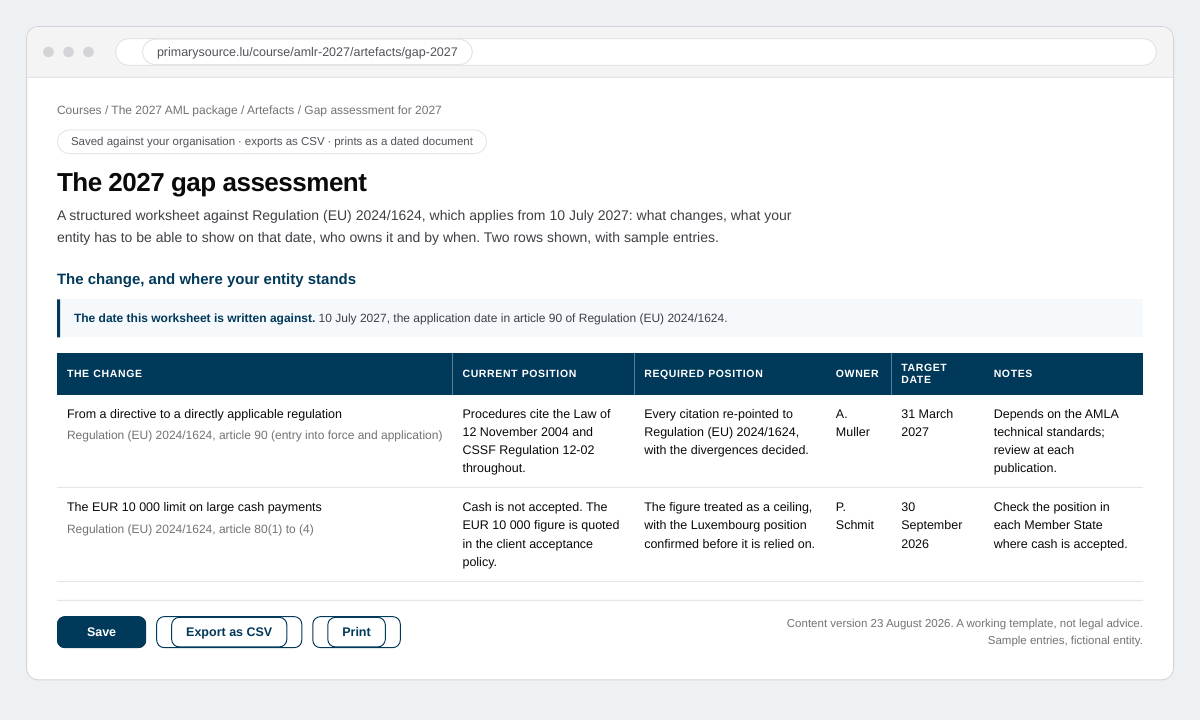
The worksheet the course is built around
Two artefacts, shared with the AML course because every row of both is built from the same instruments. The gap assessment saves what you type, exports as CSV and prints as a dated document.
How this course is built
Explore the laws and source material behind all four modules.
Articles in context
Article numbers appear alongside the points they support.
A recital is not an obligation
Where the course rests on a recital rather than on an article, it says so and stops short of stating a rule.
Sources linked, not listed
Each source resolves to its official page on EUR-Lex, Legilux or cssf.lu, so you can check the course against the instrument.
Compliance officers, conducting officers, in-house counsel and fund and ManCo staff who will have to answer, in 2026 and 2027, what the package changes for this entity and what is being done about it. It assumes you already work under the Luxembourg framework.
The ability to say what direct applicability changes and what it does not, what the citation work in your own documents amounts to, the three figures stated the way the text states them rather than the way they are repeated, which parts of the package are a restatement and which are genuinely new, which of the two roles of the AMLA reaches your entity and which does not, the difference between being eligible for consideration and being selected, what the European data collection templates are already doing to the answers you give, what harmonisation costs a group and in which direction, what the training obligation now covers and who is in it beyond your payroll, what a recital does and does not oblige between a fund and its manager, the eight rows of the gap analysis, and how to sequence them so the plan produces something.
The whole course is on sale now
12 lessons across four modules, with a certificate at the end of each one.